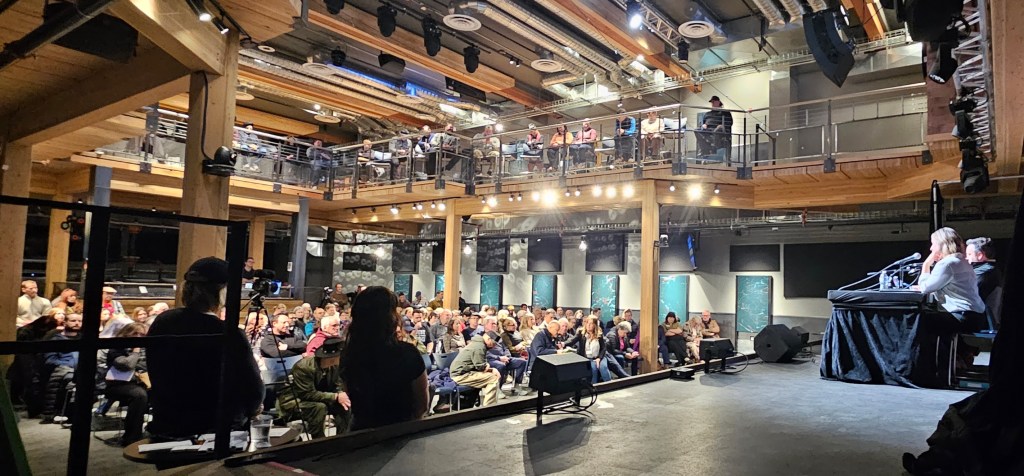
Two weeks. Two meetings. Hundreds of people. Recurring themes. And one item notably missing from the agenda.
Kelowna residents and business owners feel under siege, like the waves of social disorder keep encroaching farther up the shore and are threatening to swamp them and irrevocably change the culture of the city.
It’s a feeling that probably seems familiar to many across the province. This week’s Town Hall on Public Safety put on by the local MLAs allowed for a venting of complaints, a release valve that allowed people to share the various ways they feel unsafe. The grievances were not new: a bail system that allows a catch-and-release system to thrive; lack of treatment options; and a provincial government that has focused all its efforts on harm reduction. More resources, they said.
The Community Safety Forum for Businesses the week before, put together by the City of Kelowna, was more of an informational session where it was laid bare how the current resources were being deployed and some new ones that might be coming were shared. We hear you was the message from those on stage and we’re doing what we can.
Common at each session was the underlying theme that people living on the street, who suffer from addiction and mental health issues, need true compassion. No one suggested that allowing them to suffer was compassionate. They needed help.
Interestingly, the head of the Kelowna RCMP was the pithiest.
“We cannot out-police bad public policy. We cannot arrest our way out of addiction and we cannot social service our way out of chronic criminality,” said Supt. Chris Goebel. “We need a balanced approach that actually works, and the reality on the ground is that years of policy heavily weighted towards harm reduction, without the same scale of effective voluntary treatment, without mandatory treatment pathways for those who will not choose help, has not delivered on public safety.”
That was echoed by Kelowna-Mission MLA Gavin Dew who told the crowd at Revelry the province had got it wrong. “They have invested disproportionately in harm reduction and not in all of the other things that we need in order to actually help and support people and get them to a point where they can recover and regain control of their lives,” Dew said. “That is the philosophical change that we need to make. It is not sufficient to warehouse people in addiction. It is not sufficient to provide basic survival. It is not compassionate to believe that somebody being revived with Narcan 13 times in a month represents compassion.”
This is crisp summation of the problem. Mandatory care is not a panacea, the lack of treatment beds is shameful and access to counselling early is vital. The one item missing: housing.
Creating a treatment system that puts people on a path to recovery is designed to fail if it doesn’t address the housing situation. Getting someone through detox, putting them into treatment and then dumping them back into the same precariousness is the definition of futility.
And BC Housing is a major source of the ineffectual cycle we find ourselves in. (We’ll leave NIMBYism for another day)
What is BC Housing? Is it a landlord? Is it a builder? Is it a funder? Can it be all these things at once? The current funding system is a little like Hunger Games: Housing Edition. A sum of money is put out and organizations must fight over it, projects become mired in red tape and the rules mean small non-profits cannot afford to take the risk.
Another notorious obstruction thrown up by this Crown Corporation is its remarkable inflexibility when it comes to innovation. BC Housing has a menu of services and there’s no substitutions allowed.
This is not to question the desire at BC Housing to do good. The challenge is a system that, more than many Crown corps, is intrinsically tied to the government’s political fortunes. Former premier John Horgan declared “our plan calls for 114,000 new units to be built over the next 10 years. Co-op housing, rent purpose housing, not-for- profit housing and market-based housing.” That was nine years ago. It hasn’t happened.
It’s time to review what BC Housing is and will be. One thought: use the financial resources of the province to build some of the needed homes, tie it with apprentice training, and then have them managed by non-profits. And have a second, smaller project fund for innovation. Plus, end the competitive approach to funding: give each region the money and let local decisions be made on these smaller projects.
Cities are stepping up and trying to maintain decorum on our streets. What we really need is a system that is truly Housing First or the cycle of futility won’t be broken. If we want to help people, they need to be housed.
 42nd & Grace
Leave a comment