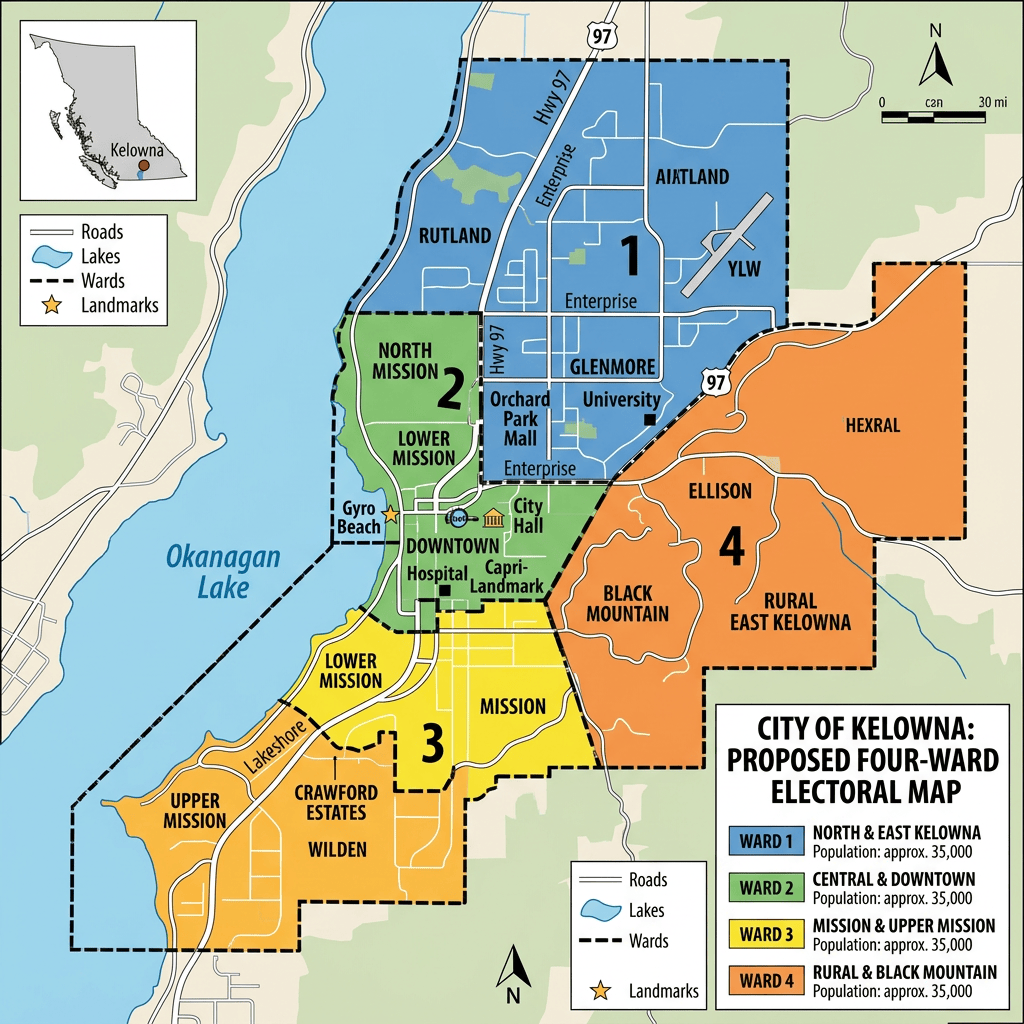
For the most part, politicians genuinely try to do the right thing. However, you can always count on them to protect the systems that grant them power. While they consistently frame their decisions as being in the public interest – and occasionally, they are – more often than not, it comes down to political survival.
Consider Justin Trudeau’s infamous 2015 promise that it would be the last federal election under first-past-the-post (FPTP). Or former BC Premier John Horgan’s strict insistence that taxpayers would never fund political parties. Today, FPTP remains intact, and BC taxpayers provide roughly $3.8 million annually in subsidies to the NDP, Conservatives, and Greens.
That same instinct for self-preservation was on full display when Kelowna City Council refused to even study a ward system last year. The reluctance of municipal politicians to entertain electoral reform is deeply rooted in vested interest. When nominations closed for the October 17 municipal election, the reality of the situation became impossible to ignore: a staggering 38 candidates are vying for just eight council seats, giving incumbents a massive advantage.
Naturally, no sitting politician will admit to benefiting from the status quo. Instead, they rely on a predictable set of talking points. Let’s dismantle those arguments and examine how a ward system could actually strengthen local governance.
Myth: “We represent the entire city”
This is always the first line of defense. Incumbents argue that an at-large council keeps the best interests of the entire community at heart, whereas a ward system would pit neighborhoods against one another.
Tell that to the residents of Kelowna’s lower-income neighborhoods, who routinely feel left out of the conversation. There is a reason British Columbia is divided into 93 provincial constituencies: it ensures every region has a dedicated voice for hyper-local issues. Kelowna is represented by three MLAs (four including West Kelowna), each balancing provincial policy with local advocacy. By the logic of the “at-large” crowd, we wouldn’t need multiple MLAs; a single person could simply represent the collective provincial will.
Wards exist to guarantee residents a direct line to city hall while ensuring they remain part of shared, city-wide decision-making. Would dividing Kelowna into four wards with two councillors each really be so disruptive? Would giving a distinct community like Rutland a guaranteed seat at the table ruin the city? Crucially, the mayor would still be elected at-large to maintain a unified, city-wide vision.
The Incumbency Shield
The real reason politicians refuse to study a ward system is the sheer power of incumbency. In an at-large system, an incumbent only needs to finish eighth to secure their seat, making re-election highly probable.
A ward system shatters that safety net. It forces a tough question: where do you run? If the majority of current councillors happen to live in the same affluent neighborhoods, they would suddenly have to compete directly against one another to finish first or second. It slashes their odds of survival—and few politicians willingly vote to jeopardize their own jobs.
The Need for “New Blood”
Because the at-large system protects incumbents, it inadvertently blocks fresh faces and diverse perspectives from entering city hall. A ward system levels the playing field, creating an accessible platform for new voices, varied life experiences, and innovative ideas. This kind of civic renewal should be actively championed, not suppressed.
Genuine Community Engagement
Have you ever felt like city council simply isn’t listening? In a ward system, you know exactly which councillor to call when a problem arises in your neighborhood. Your representative is someone who has likely knocked on your door, understands your streets, and might even live down the block. It forces municipal attention onto local issues that might otherwise be dismissed as insignificant on a city-wide scale.
Looking Ahead
It is too late for the upcoming election, and it is entirely unrealistic to expect career politicians to willingly vote against their own self-interest. But true democratic representation belongs to the neighborhoods—and achieving it requires political will that the current council simply lacks.
 42nd&Grace
Leave a comment